Key Points:
- Search now includes AI summaries and faster credibility judgments.
- Consolidate overlapping pages so one clear answer ranks reliably.
- Define page roles to reduce cannibalisation and improve navigation.
- Monitor intent drift early and refresh sections, headings, comparisons.
- Strengthen entity signals with consistent branding, proof, and sources.
- Technical hygiene improves crawling, indexing, and performance across key pages.
- Reporting should link visibility to enquiries, conversions, and pipeline impact.

Search feels a little different now. People still Google, sure, but they also glance at AI summaries, click the suggested follow-ups, and make a quick call on whether a brand seems legit. So “good SEO” is less about pumping out content every week and more about having a few strong pages that load fast, say something useful right away, and match what the person is actually trying to figure out.
Brands that adapt early usually get noticed in more places. They keep showing up in the regular results, and they also have a better shot at appearing in newer discovery spots where visibility feels earned instead of bought. There’s no magic trick behind it. It comes down to clean site structure, clear trust signals, content that answers real buyer questions, and steady updates that keep things relevant as the market shifts.
AI-Led SEO Cleanup That Reduces Ambiguity across Key Pages
An AI SEO agency often starts by removing the ambiguity that has built up over time. They look for overlapping service pages, duplicate location variants, thin category sections, and internal linking that sends mixed signals. Then they consolidate and sharpen the strongest pages instead of spreading authority across dozens of near duplicates. When the site has one clear answer for each core intent, indexing becomes steadier, and rankings feel less fragile.
The cleanup is not only technical. It is structural and editorial too. Navigation is tightened so priority pages are easier to reach. Internal links are rebuilt to support content points that point to the pages that should convert. When the architecture is coherent, search engines crawl more efficiently and users move through the site with less friction. That is how clarity becomes a competitive advantage, not just a housekeeping task.
Smarter Search Favours Clear Page Roles over Content Sprawl
Modern search rewards clarity. When a website has five pages saying almost the same thing, engines struggle to decide which one should rank, and users feel the confusion too. The stronger move is defining page roles: one core page per offer, supporting pages that answer specific questions, and a clean path between them. That structure reduces self-competition and makes relevance easier to interpret.
It also improves the human experience, which matters more than most teams admit. Visitors skim headings, scan proof, and look for the next step. When the page order matches their thought process, they stay longer and click deeper. Those behaviours are signals that search systems notice. Clear roles also make it easier to maintain the site, because updates happen in the right places, not everywhere at once.
AI Intent Drift Optimisation That Protects Rankings before They Slip
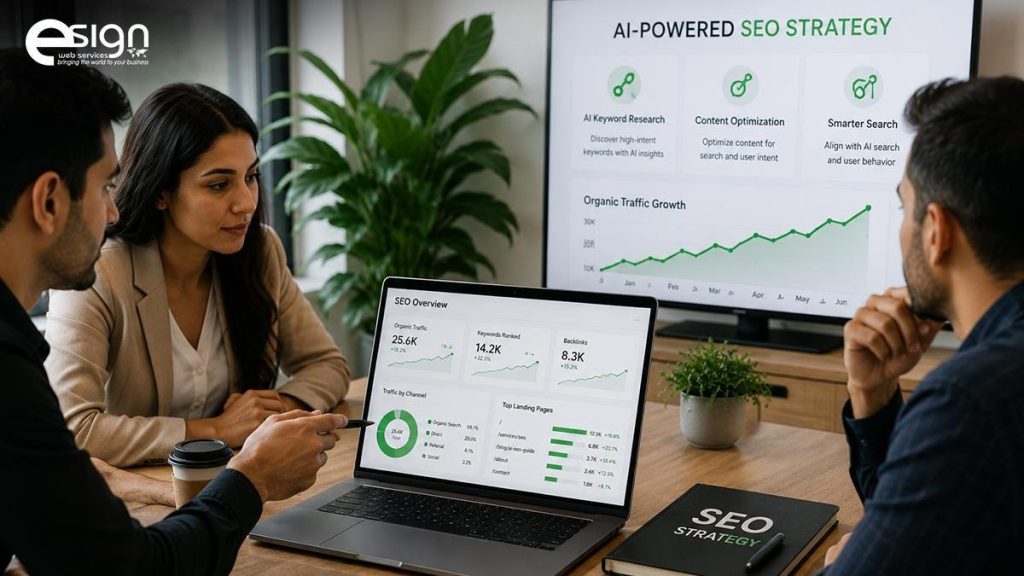
The best AI SEO optimisation services treat intent as something that moves, not a fixed target. A page can be “correct” today and slightly off next quarter because customers change phrasing, competitors reframe offers, or the market becomes more price sensitive. AI-supported monitoring can surface those shifts earlier by tracking query patterns, SERP features, and the kinds of pages that are being rewarded for a topic.
Once intent drift shows up, the fix is usually precise. Headings can be tightened, sections can be reordered, and missing comparison details can be added where buyers tend to pause. A page might need clearer boundaries, stronger proof, or a better next step. These are controlled updates, not constant rewrites. The goal is to keep content aligned with real decision behaviour, so visibility holds while the market changes.
Entity and Trust Signals Improve Discovery Inclusion
Smarter discovery systems do not evaluate a single page in isolation. They look at the brand behind it. Consistent naming, a credible About presence, aligned service descriptions, and a clean footprint across reputable sources all reduce doubt. When these signals match, the business looks more like a real entity and less like a generic site. Buyers respond the same way. They hesitate less when things feel consistent.
An agency can strengthen entity trust without making the site feel overproduced. They help brands present expertise through specific service boundaries, credible proof, and content that actually answers questions with useful detail. Structured data can reinforce clarity, but the bigger win is consistency across the site and across the web. When credibility is visible, the brand is more likely to be surfaced in smarter discovery environments, not only in standard rankings.
Measurement That Links Visibility to Real Business Outcomes
The most useful SEO measurement is not a ranking screenshot. It is a view of what visibility is doing for the business. That includes qualified sessions to priority pages, conversion actions by landing page, and which queries are bringing late-stage visitors who are ready to compare and decide. This lens stops teams from celebrating traffic that does not convert, and it keeps the work tied to pipeline reality.
The best AI SEO optimisation services also use reporting as a decision tool, not a monthly recap. If a page gets clicks but weak enquiries, the issue may be positioning, proof, or page flow. If a page converts but lacks reach, the next step might be stronger internal linking, tighter topical support, or a clearer intent match. This prevents reactive changes, and it keeps optimisation steady, measurable, and commercially grounded.
Conclusion
Smarter search and content discovery reward brands that reduce ambiguity and build trust at both the page and entity level. When technical foundations are clean, content matches real buyer intent, and credibility is consistent across the web, organic visibility becomes steadier. Over time, this creates a healthier pipeline that is less dependent on paid spikes and more resilient when costs, competition, and algorithms shift.
eSign Web Services helps brands adapt to modern search with structured SEO execution tied to measurable outcomes. Their team supports technical cleanup, intent-led content planning, and practical optimisation priorities that strengthen rankings while improving lead quality, so growth feels consistent even as search keeps evolving.
Frequently Asked Questions
Question: How does AI change what brands should focus on in SEO?
Answer: It increases the value of clarity and trust. Brands benefit by strengthening core pages, improving entity consistency, and answering decision-stage questions with specific detail. The goal is not more content, but better structured information that helps buyers choose.
Question: Can AI tools replst place to start improving discovery visibility?
Answer: Start with the pages tied to revenue. Improve headings, section flow, proof points, internal links, and performance. These upgrades often lift conversions quickly and create a stronger base for building topical authority.
Question: How should brands measure success beyond rankings?
Answer: Track qualified sessions to priority pages, conversion actions like calls or form fills, and the queries bringing late-stage visitors. Rankings are context, but lead quality, conversion rate, and pipeline contribution show whether SEO is working.
Question: What causes visibility to drop even when the content looks fine?
Answer: Intent can drift, competitors can refresh pages, or technical inconsistencies can weaken indexing. Sometimes the page still reads well, but it no longer matches what searchers want. Reviewing engagement, crawl signals, and query trends usually reveals the cause.
ESIGN WEB SERVICES PVT LTD
3rd Floor, Plot No 24, Pocket 3, Sector 11 Dwarka, Dwarka, New Delhi, Delhi, 110075
https://maps.app.goo.gl/7AZXBm19Cs9LS5fk7

